Public case study and competency dossier
Make the work inspectable without exposing the production layer.
- Publish a reproducible sanitized demo with cards, architecture, benchmark, and failure evidence.
- Write an honest CineQC Hybrid case study with explicit public/private boundaries.
- Create a concise narrated defense and map job competencies to inspectable Git evidence.
Separate what can be publicly reproduced from what must remain private and explain why.
Package the work as evidence a hiring team can inspect. Required route: public/private audit (60 min), sanitized demo (90 min), case-study narrative (80 min), dossier and Git evidence (65 min), narrated defense (65 min), selected reading (60 min). Total: 7 hours. Optional external review and polish are excluded.
Entry diagnostic
Sort proposed assets into public, private, or omit. For every public claim, point to a runnable artifact; for every private item, explain the production need and access boundary.
Self-check
Can an architecture diagram expose customer filenames or storage locations even when no image is shown?
Why this matters in CineQC
A certificate says a curriculum was completed. CineQC Hybrid shows the work: data contracts, deterministic and learned signals, tests, benchmark decisions, integration boundaries, failures, and communication. The proof is valuable only when it is reproducible, privacy-safe, and modest about scope.
Visual model — two-layer proof
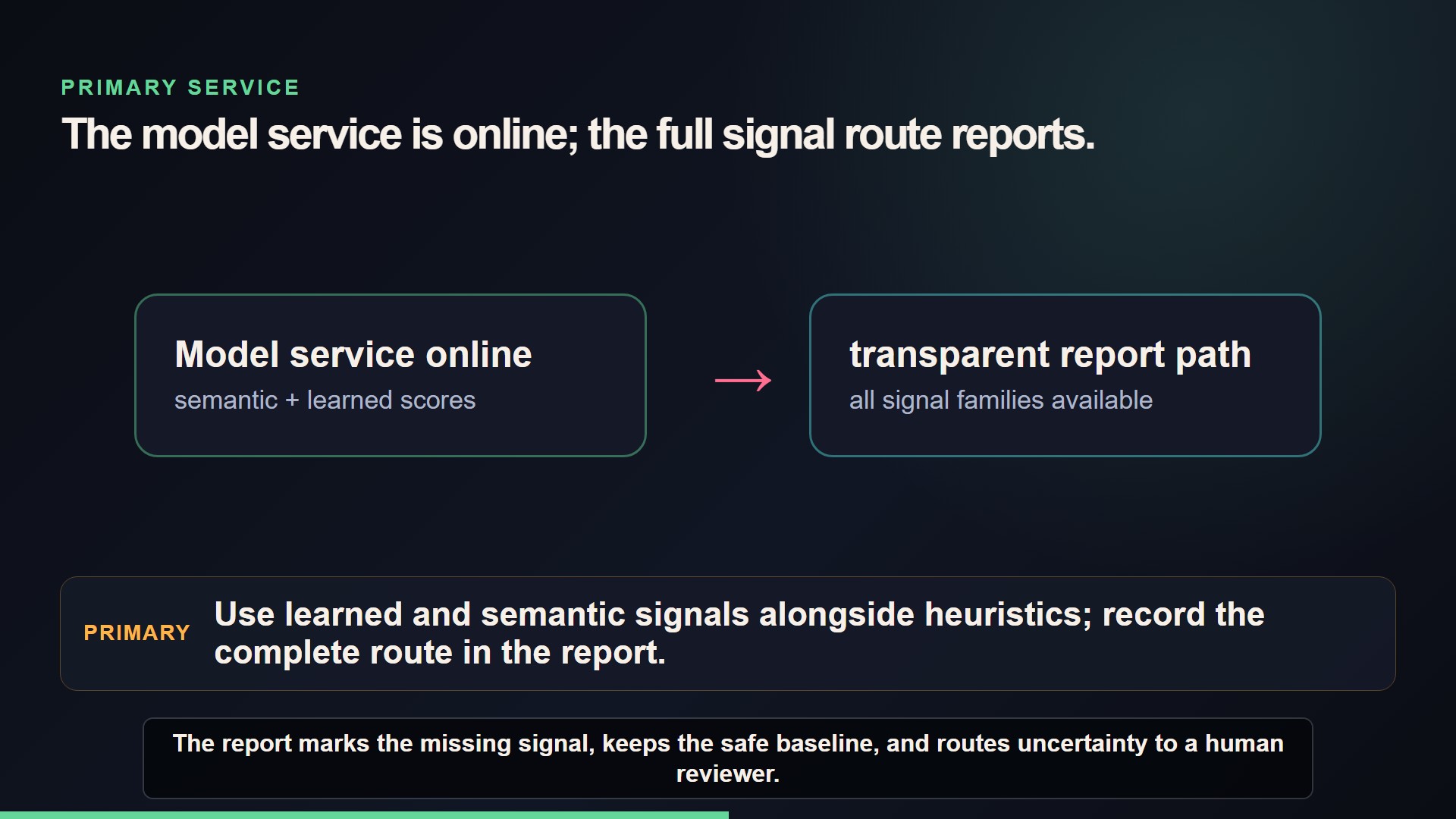
Complete hybrid system map with fallback, review, report, and proof routes. If the video cannot play, this image and the transcript preserve the complete teaching claim.
Build a clear public/private split. The public layer contains a reproducible sanitized demo, lawful generated/public fixtures, setup instructions, fixed prediction samples, benchmark narrative, model card, system card, dataset card, architecture diagram, failure gallery, tests, selected Git evidence, and concise narrated defense. The private production layer contains customer media, internal storage paths, production configuration, secrets, raw logs, full evaluation, and proprietary CineQC implementation details.
Publish an audit table with artifact, layer, reason, sanitization, license/provenance, and verification. A filename changed to “sample-01” is not sanitized if pixels, text, metadata, or commit history still identify the source.
Self-check
What makes a benchmark narrative defensible: the decision, protocol, result, failure evidence, and limitation—or only the best F1?
Case-study spine and competency mapping
Write the case study as production problem → constraints → selection rule → system → evaluation → integration → failures → limitations → next decision. Recompute displayed results from saved predictions. The model card describes model purpose and evaluation; the system card describes heuristics, model, fallback, review, privacy, and operation; the dataset card describes lawful sources, labels, splits, exclusions, and limitations.
Map each job-relevant competency to inspectable evidence: Python and debugging to focused commits/tests; visual computing to Media Probe and Artifact Lab; data discipline to label guide and dataset card; PyTorch to reproducible training; evaluation to saved predictions and benchmark; APIs to FastAPI contracts; privacy/product judgment to the layer audit and review routing; communication to the architecture walkthrough and narrated defense. Avoid proficiency percentages and invented certification language.
Sandbox lab
Assemble the CineQC Hybrid public case study plus clearly separated private production layer and inspectable competency dossier. Start from a clean clone or export, install pinned dependencies, run the sanitized demo, rebuild metrics, exercise API success/fallback/failure, and compare output checksums with the release manifest. Capture only public-safe screens.
Build a failure gallery with false positive, false negative, corrupted-input, timeout/fallback, and out-of-scope examples. Each card shows safe input evidence, expected/observed behavior, production consequence, diagnosis, present mitigation, and next experiment. Link claims to stable repository paths, release tags, small reviewable commits, and test commands as Git evidence.
Failure clinic
Remove copied private thumbnails, local usernames/paths, API keys, internal hostnames, raw OCR text, unverifiable metrics, cherry-picked successes, hidden fallback, and claims broader than the fixed tests. Inspect repository history and generated files, not only the current folder. If safe provenance cannot be demonstrated, replace the example with controlled generated media or omit it.
CineQC transfer
Create a 90–150 second narrated defense in the DVP motion language: dark editorial field, amber/blue signal paths, restrained kinetic type, readable evidence cards, and no decorative claim inflation. Show the problem, hybrid architecture, one benchmark decision, one failure, privacy boundary, and where a reviewer can reproduce the result. Captions and transcript are required; optional polish does not extend the course.
Self-check
Which competency mapping is stronger: “advanced ML — 90%” or “evaluation — recompute script, saved predictions, fixed-set checksum, and benchmark commit”?
Evidence gate
Release the CineQC Hybrid case study, sanitized demo, benchmark narrative, model/system and dataset cards, architecture diagram, failure gallery, Git evidence, public/private audit, competency mapping, setup/reproduction record, and concise narrated defense. Keep the private production layer clearly named but inaccessible. An optional external review may improve clarity after release; it is not required, not counted in seven hours, and does not become a credential.
One-page summary
- Public proof is lawful, sanitized, reproducible, and inspectable.
- Private media, secrets, configuration, logs, and proprietary details stay private.
- Cards constrain data, model, system, and claim boundaries.
- The case study shows decisions and failures, not only wins.
- Competencies map to files, commands, tests, commits, and artifacts.
- A short DVP-language defense makes the evidence navigable.
- External review and polish are optional and excluded from required time.
Use the reporting questions to constrain intended use, evaluation, limitations, and claims in the public case study. · 30 min
Reuse selected documentation prompts when auditing the sanitized public sample; the full paper is optional. · 15 min
Flagship Release 2: CineQC Hybrid public case study plus private production layer.
Check the statements you can demonstrate in the challenge. Selections route your learning; they are not proof of mastery.
Start the full milestone.
Submit an inspectable artifact for independent review. Only a verified diagnostic challenge or reviewed evidence can mark this milestone proven. Proof is local self-tracking, not tamper-resistant against edits to this browser storage.
- Publish a reproducible sanitized demo with cards, architecture, benchmark, and failure evidence.
- Show a competency dossier with cards, Git evidence, benchmark, and failure gallery.
- Explain the narrated defense, public/private audit, and limitations.
Current state: not-started. Advance through learning, practice, and submitted evidence; proof requires a later passed review.
Your local study notes mount here when JavaScript is available.
Teaching modes mount here when JavaScript is available. The readable course remains available without them.