Build the cut
Add up to 12 stills, short clips, or a mixture. Put them in editorial order with the arrow controls.
Field guide · lighting continuity
LightLock turns the instinct that “this cut feels wrong” into a sequence map, evidence you can inspect, and a lighting-only repair instruction for the next generation.
The workflow
Add up to 12 stills, short clips, or a mixture. Put them in editorial order with the arrow controls.
Use shot 1, mark another sequence shot, add a separate hero still, or import a saved FrameDNA lighting profile.
Describe camera-axis changes, blocking, windows, practicals, or an intentional time-of-day transition so visual change can be judged in context.
LightLock samples each clip, asks Gemini for cautious lighting observations, then calculates every comparison locally.
Send the strongest failure, evidence, positive constraint, and negative constraint directly into Shot Doctor.
Three synchronized views
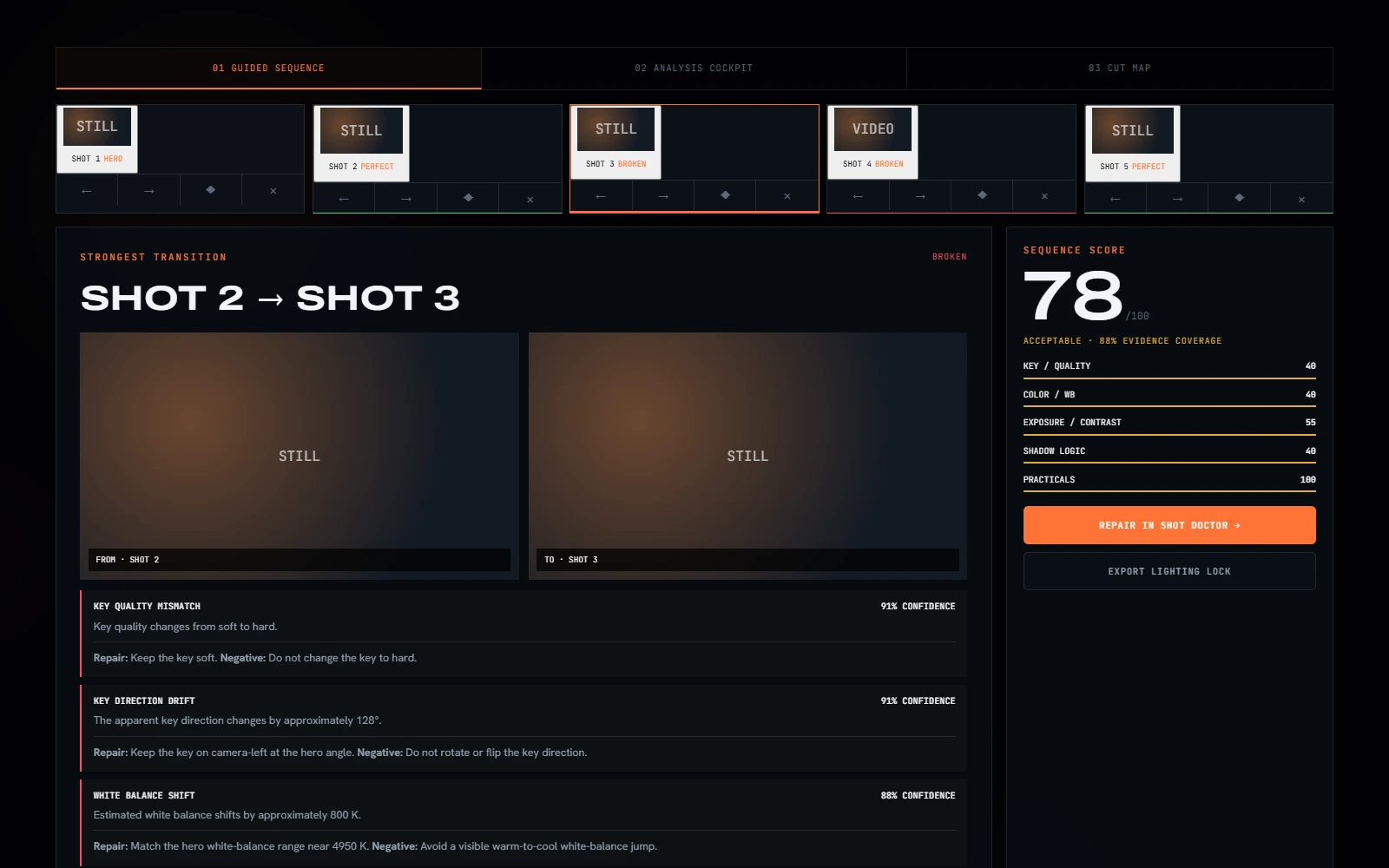
The default production path: order the shots, choose the hero, see the sequence score, and act on the strongest transition.
Inspect the normalized lighting DNA of one shot and use the matrix to compare any pair without rerunning Gemini.
Treat every editorial transition as a checkpoint. Select the line between two shots to see exactly what changed.
Scoring language
LightLock scores key direction and quality, color and white balance, exposure and contrast, shadows, and practical-source motivation.
The lighting relationship is coherent at the available evidence level.
A difference is visible, but it can survive the cut or deserves review.
A high-confidence, unmotivated change is likely to pull the audience out of the scene.
The frames do not support a trustworthy judgment. LightLock refuses to fabricate a failure.
Read the confidence and evidence coverage beside the score. Direction, Kelvin, and exposure values are estimated visual anchors, not photometric measurements. They are written as “apparent” and “approximately” for that reason.
Privacy and control
Files and previews stay inside your browser. LightLock does not upload or store the sequence.
Only sampled frames are sent directly to Google Gemini under your Gemini key. DynamicVibe never receives the media or key.
The lighting lock export contains normalized profiles, findings, overrides, and repair constraints—never image bytes, preview URLs, or keys.
Editorial judgment
A reverse angle, subject turn, switched practical, or day-to-night beat can produce a real lighting change that is still motivated. Choose Mark intentional transition and add a short note. LightLock preserves the original observation, records the decision, and updates the editorial sequence judgment.
The continuity chain
Decode the hero look, measure how the sequence holds it, then repair only the lighting on the shot that drifted.
Open LightLock